The Curse of Mississippi

Mississippi is the worst state. Let me give you anecdotal evidence to scientifically prove my point.

Every time my team went to Mississippi in college, something bad happened.

In January 2010, we came back to Berry a few days before the semester started, so we could travel to Jackson, Mississippi for the Mississippi Blues Half Marathon. To date, this is the coldest race I’ve ever run. This is what I wore to packet pickup the day before:

It was 18 degrees at the start, and many of us pulled something during the race just from our muscles’ inability to warm up. Volunteers were furiously sweeping up the cast aside water cups on the course water stops since any remaining liquid immediately froze once it hit the ground, creating an icy patch for runners to cross. Teammates finished with their sweat frozen to their faces and had icicles in their hair. We huddled together wrapped in space blankets, happy to head back to the motel for hot showers.

Unfortunately some of the doors wouldn’t open when we got back. The rooms that were closest to the pool were the least protected from the cold temps, so the doors were frozen shut. This delayed our departure as it took maintenance almost an hour to get all of those doors open.

When we finally got on the road, we started planning activities for that evening. It was our teammate Taylor’s birthday, and Jackson back to Berry was only about 6 hours, so we had plenty of time for birthday festivities.

After some time on the road, there was some traffic on the interstate. I’m not sure how long we sat completely motionless on our Leisure Time charter bus before someone started investigating (this was pre-smartphone for me). There was a jackknifed tractor trailer a few miles ahead, and the whole interstate was shut down. With a wall of cars in front of us as well as behind us, there was nowhere to go.

We spent 3 hours sitting in the same spot. Despite the fatigue from the half marathon, knowing that we couldn’t move resulted in a fair amount of cabin fever. During those 3 hours, we fit Michael (a tall skinny runner, who would imagine we had one of those?) into the overhead baggage compartments, had a dance party, and wrapped Jacque up in toilet paper like a mummy (I decided against photos to protect the innocent).

All in all, we made it home, no one was hurt, and we were able to celebrate Taylor’s birthday the next day. This trip did make all of us a little suspicious of Mississippi, though.

The nail in the coffin for Mississippi came the next school year in the fall. We were going to a new cross country meet – the Brooks Memphis Twilight. This was exciting because it was a night race, and my aunt and uncle were living in Memphis at that time, so they could come to the race.

To get to Memphis, you have to go through Mississippi. We were in the middle of the state when the bus driver put on his hazards and pulled over to the shoulder of the interstate. Apparently some part of the roof of the bus near where his sun visor attached was broken. I to this day don’t believe it was stop-worthy, but safety first, I guess.

It quickly got very warm on the bus, so a lot of us ventured outside, just hanging out on the side of a major interstate. Thankfully it was wooded for the inevitable needs of well-hydrated runners.

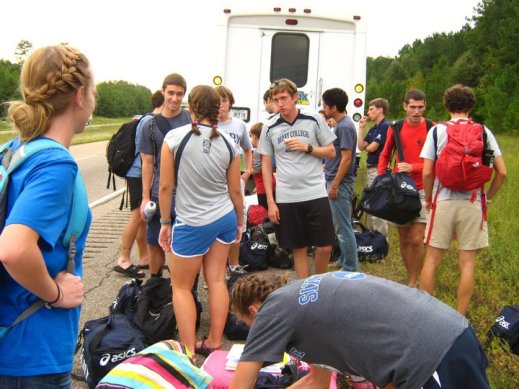
After an hour or so, the bus driver let us know that another bus was on the way, and he needed to take this bus to a mechanic. We had to unload all of our stuff and watch the bus drive away (cough, fully functional, cough) and look like a group of matching homeless people.

Thankfully, our coach had the infinite wisdom to plan for an extremely early arrival, so we would have time to explore the city a little bit. Despite the unfortunate circumstances, we knew we should still make our races.

Finally, after another hour, a new bus showed up! Instead of the usual charter bus, it was a tour bus, and it had (allegedly) shuttled Jason Mraz around the night before. Happy to have a new means of transportation, we crammed into the new bus. Rather than the usual rows of seats, this bus has a few leather bench couches, so it was a tight fit for a group our sized with each person also having a duffle bag.

We made it to the race venue in just enough time to drop our stuff and get in a warmup. We cut it close for sure, no thanks to the traffic we encountered once we got into the city, but the night races were a success!


While these stories both have (eventual) happy endings, I still believe this offers definitive and objective evidence for Mississippi being the worst.


Women’s Elite Field for Boston 2018

I encountered a Twitter storm Monday afternoon as the Boston Athletic Association announced the elite field for the 2018 Boston Marathon. My (biased) opinion is that US women marathoners are the most exciting segment of distance running right now, so I wanted to take a closer look at just how stacked this field is.

Shalane Flanagan 

Fresh off her first major marathon win in New York, Flanagan decided she wasn’t quite ready to retire yet and is making a run for another major title. The Boston native has always had her eyes on a win in the hometown marathon and would certainly be the cherry on top of a successful career before retirement.

Fun fact: “Every single one of her training partners — 11 women in total — has made it to the Olympics while training with her, an extraordinary feat. Call it the Shalane Effect: You serve as a rocket booster for the careers of the women who work alongside you, while catapulting forward yourself.” Read more here.

PR: 2:21:14


Sara Hall 

Hall is also fresh off a win. With a solo effort for the vast majority of the race, Hall dominated the field at the USATF Marathon Championships earlier this month, running just a few seconds off a PR that she set five weeks prior. Coached by her husband, American Marathon Record-holder Ryan Hall, Sara is definitely coming into form for the marathon after moving up to the distance a few years ago.

PR: 2:27:21


Desi Linden

Desi holds the best finish at a past Boston Marathon when she was 2nd in 2011. Linden is one of my favorite marathoners to watch as she is a complete metronome. During the 2016 US Marathon Trials, her consistency awarded her a 2nd place finish after she didn’t chase the breakaway that Flanagan and Cragg made earlier in the race.

PR: 2:22:38


Molly Huddle

Molly is the American Record-holder in the 10k from the 2016 Olympics (which I cried while watching) where her breakout performance was redemption from her missing out on a medal at the World Championships the year prior.

The marathon is relatively new to Huddle as Boston will be her second marathon after her debut last November. She’s no stranger to success on the roads, and I’m excited to watch her make the transition into the longer distance.

PR: 2:28:13


Jordan Hasay

Jordan is the most exciting new(ish) addition to the American women marathoners. Hassay’s Boston debut last year was the fastest marathon debut of any American woman by nearly 3 minutes. She followed up on that performance with a blazing 2:20:57 at Chicago this fall, putting her at #2 on the list of American female marathoners.

From watching Hassay run the 1500 meter Olympic trials as a high schooler to competing for the dominant Oregon Ducks in college to having some injury struggles post-college, it’s satisfying to watch her find her stride again in the longer distances.

PR: 2:20:57


Serena Burla

Full disclosure, I didn’t know anything about Serena Burla except recognizing her name as an elite runner. As it turns out, she has an incredible story! She’s a cancer survivor, and a surgery in 2011 to remove the cancer also took half of her hamstring. She underwent surgery again in August after finding another malignant tumor in her leg.

PR: 2:26:53


Kellyn Taylor

Kellyn Taylor was another name that was familiar, but I had to look up some details on her. She’s a total badass – pro runner, firefighter, mom, etc. Taylor came excruciatingly close to qualifying for the Olympic team in 2016, finishing 6th at the marathon trials and then 4th in the 10,000 meters.

PR: 2:28:40


Deena Kastor

I saved the queen for last. Kastor is the American record holder in the marathon, half marathon among other accolades. She has an Olympic bronze in the marathon from 2004 and broke the Master’s marathon record by nearly a minute in 2015, running 2:27:47. She’ll be 45 at the 2018 Boston Marathon and will still be running away from much of the competition.

PR: 2:19:36


Boston 2018 – I can’t wait to watch! Could this be the first year since 1985 that an American takes home the crown?

Decide, Commit, Step Forward: How to Break Free from FOMO and Organize your Ambition

When I first started at Praxis, I learned that it is something I’ll always have to explain to people. The follow up question is usually about our participants who I like to describe as “exhaustingly inspiring.” Our community is constantly pinging with notifications about new websites, new blog posts, new projects, new group discussions, podcast, reading groups, etc. It’s overwhelming in the best sense of the word.

But that feeling of being overwhelmed can also be detrimental. It can cause analysis paralysis and make you not know where to start or spark 1 million half-baked ideas that you never put into action because you don’t want to give up on thinking of 1 million more ideas. We see this when people are afraid to commit to a single project idea because they don’t know if it’s the “right” one. You can experience, fear, anxiety, regret, and FOMO (fear of missing out) when you’re negatively overwhelmed, and I’m going to address how to overcome that.

First, I want to start with a little economics. Economics was my first love from when my dad was my econ teacher in high school and that led me to pick econ as my major in college and then to FEE (Foundation for Economic Education) for my first 5 years out of school. I sincerely think that economics is the single most useful subject to know and understand to function successfully in the world. One of the taglines we used when marketing FEE programs was “see the world more clearly” because looking at events through an economic lens gives you understanding and clarity.

One of the basics of economics is opportunity cost. This is a concept most people understand even if they don’t know the formal name for it. Opportunity cost is defined as the value of your next best alternative. Textbook examples usually include something like, “Sally can go to the movies with her friends or go to the baseball game with her family. Whichever thing she doesn’t choose is her opportunity cost.”

Easy, right? Everyone gets that you can only do one thing at a time, but the actual cost of what you’re giving up can sometimes be overestimated. Since you can only do one thing at a time, opportunity cost is only the value of your next best alternative, not the sum of all of the values of literally every other thing you could be doing. Choosing option A doesn’t mean your cost is B and C and D and E (and…etc); the cost is just B (assuming it’s your next best choice) because if you choose B, that precludes you from choosing the others as well.

I explain all of that to emphasize the importance of knowing the true cost of your decisions. Thinking in the flawed way of, “I’m losing out on every single other thing!” rather than only giving up the next best choice can cause major analysis paralysis. It can put more pressure than is needed on making the “right” choice because you believe the stakes are higher than they really are.

Acknowledge the opportunity cost of your decisions, and use that information to help you make the best choice.

Another note on decisions: everything is a choice. Even refusing to make a decision is a decision in and of itself. You won’t get the time back you spent deliberating or agonizing over a choice, so keep opportunity cost in mind when it comes to how much time you spend making a decision. Not every decision needs a well-constructed argument or research to back it up. For instance, I spent a few hours researching, comparing models, reading reviews, and even going to a store to look at the sizes/feel the weights when I was picking out a new laptop last year. It was a larger purchase and important purchase, so I wanted to make a good decision. I wouldn’t spend that amount of time on buying a new toaster or waffle maker. It’s just not worth my time!

That’s a simplified example, but as someone who is prone to getting sucked into reading Amazon reviews, it’s important to take a clarifying moment to judge the priority of a decision. I’m not trying to encourage rash decision making, but not every decision needs a pro-con list. Some things aren’t worth it. In fact, most aren’t.

Ranking the priority of your decisions is important because decision fatigue is a real thing. People who make more decisions throughout the day struggle with self-control and will power at the end of the day, more so than those who make fewer decisions. Interestingly, it’s also shown that judges make “less favorable” decisions later in the day than they do in the morning. (Something to keep in mind if you’re ever in court and able to pick the time of your appointment.) Another example is Mark Zuckerberg, who has been quoted as saying that’s why he wears jeans and a grey Tshirt every day. He doesn’t want to waste the mental capacity on deciding what to wear when he could use that capacity to further take over the world with Facebook.

That’s why I named the first part of this post decide. It’s important to know how to make a decision. And after you make it – commit to it. There are no time machines. So – when you make a decision, commit to it and only look forward. Thinking about what you “woulda coulda shoulda” done is a waste of your time, and regret is not a productive emotion.

I loved the Forward Tilt episode “Living with Integrity.” I excitedly slacked Isaac the morning it came out telling him it had so much in common with what I wanted to talk about at Praxis Weekend. My favorite (hypothetical) example is when he talks about his wife asking him to attend a social event that he doesn’t necessarily want to go to. He says the option that shows integrity isn’t so much about whether he decides to go or not but about his commitment to that decision. A lack of integrity would be agreeing to go to the party and then acting pouty and passive aggressive about being there, possibly ruining the outing for his wife. If you decide to go – go and be just as a pleasant human being as you would have if you stayed home.  You can’t keep one foot in your decision – it requires both feet.

I want to clarify this doesn’t mean you never change your mind or pivot away from an original decision or goal. You absolutely should do that in some cases. How you decide to do that involves thinking about how that new decision changes your next step. Another economic concept that’s important to understand is sunk cost. A sunk cost is one you’ve already paid – either with time or money or resources. My favorite example is all you can eat buffets.

If you go to a buffet and pay $25 at the door, you can’t get that money back no matter how much or how little you eat. Eating more to “get your money’s worth” is an illogical argument, and you should only base your decision to get another plate of food on if you think it will make you feel happier (do it!) or sick (don’t do it).

So yes, past information is helpful when making current decisions, but you base your decision on how it will affect your future – looking forward. When I was coming up with the outline for this post, I pictured it as describing life as a choose your own adventure book. At the end of each chapter, you have to pick which way to go, commit to that decision by turning to the correct page, and then step forward by starting your new chapter. Then repeat.

Continuing with that example, some chapters are longer than others. Praxis curriculum is built around 30-day PDPs (personal development projects), and you have the freedom to learn a different skill every month or spend 3, 6, etc months building on a single skill. Devoting a month to something is a great, low-risk way to test if you want to pursue it further. If you dedicate a month to learning guitar and find that music isn’t your thing, it’s not a big deal! You learned something about yourself and can adjust accordingly for your future goals and learning.

It’s up to you to determine which activities and goals to pursue further and which to give up through honest self-assessment. Grinding through something you don’t always like or doesn’t “feel” fulfilling is important if it moves you toward bigger goals, but grinding for the sake of grinding is not and is a waste of your time.

Now that we’ve discussed the proper framework for good decision making, here are my tips for “organizing your ambition.” I will use my favorite example from my own life – running.

  1. Pick a goal

Here I’m talking about your long-term goals, not something you want to accomplish in 30 days. This should be something difficult that you might spend years of your life inching toward. SMART goals are important, so make sure you strike a balance between challenging and realistic. For instance, my goal doesn’t have to do with running at the Olympic level because that is hilariously unrealistic.

But my goal is challenging. It’s to break 18 minutes for 5k. I’ve been working on getting faster technically since I was 12 but seriously toward this goal since I was 19 or 20. I’d like to accomplish it before I have kids, so I have roughly a 10-year deadline.

  1. Document your progress

This is so important in your professional career! If you have a portfolio of projects that demonstrate the value you can create, you immediately set yourself apart from a crowd. You won’t be in the stack of 1,000 other resumes, and you’ll have credibility with an interviewer. Think of the difference between saying, “I build websites and proficient in X coding languages” and saying that plus having examples of the websites and client testimonials.

Having documentation also allows you to see the progress you make toward your goal. I’ve kept an online running log since 2007, so I have over 10 years of data to look back on. The documentation is also helpful for when I need an expert’s advice, which leads to my next point.

  1. Get a coach

Remember decision fatigue from earlier? It will be much more taxing both mentally and physically if you’re having to teach yourself the basics AND research the best resources AND try to put it all into practice AND get feedback on how you’re doing.

I “coached” myself for about a year out of college. I use the word coached very loosely because I had no idea what I was doing. I mainly looked at my running log from college and would randomly pick workouts and do them. It was hard to know what paces to aim for, and I can remember the pressure of trying to decide what I was going to do the next morning before I went to bed.

I finally asked one of my teammates from college who was coaching if he would take me on, and he did. Not only did my decision fatigue decrease, but there’s also something really helpful about having someone else challenge you and believe in you. You get an extra bump from the external motivation because your coach isn’t going to purposely set you up to fail. If you have a hard workout assigned, you get the boost of confidence from knowing, “He thinks I can do this.”

Sometimes you need the kick in the butt form of external motivation as well. This story isn’t my own, it’s from a runner friend who posted it on Facebook. She went to see a PT who asked her if she had been doing her exercises and stretches and foam rolling. Her answer was some form of “not as much as I should.” His answer sticks with me today.

“Oh I’m sorry. I thought you wanted to be fast.”

It sounds really harsh, but it has motivated me countless times since I heard it. You see, running is the easy part of training. The hard parts of training are lifting weights, stretching, eating right, turning off Netflix to get 8+ hours of sleep, etc. If I’m ever lacking motivation, I sassily say to myself, “Oh, sorry, I thought you wanted to run under 18,” and that helps get me going.

Find a coach. Find someone (or a handful of people) who will be fitness trainers for your goals and career and who will give you the kick in the butt when you need it and who will celebrate with you when you meet your goal.

  1. Be unapologetic about your goals.

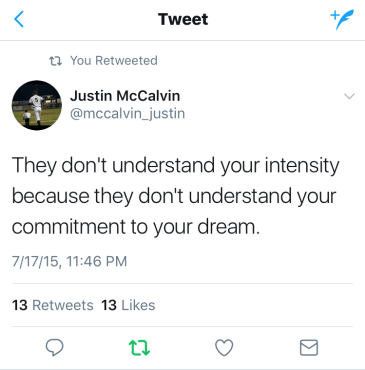
I love this tweet. I have no idea who this guy is, but this tweet stood out enough in my memory for me to scroll through 2 years of my twitter page to find it. I ended up Googling him and found out he’s a baseball player, so the athlete analogies continue.

If you’re a highly-motivated doer, you already know you’re weird. People don’t always understand why you’re so driven or how you get so much done. Sometimes this inability to understand comes out as their own insecurity, so they make fun of you. To that I say, SHAKE OFF THE HATERS. Recognize their negative attention for what it really is – their defensiveness and insecurity about pursuing mediocrity.

I’m definitely not saying to go around having an elitist attitude toward everyone. Sometimes you just have to remind yourself that you’re pursing your goal for YOU and because YOU’RE interested in it. It doesn’t matter what other people think.

  1. Don’t be a martyr.

Another way to be unapologetic about your goals is the more literal sense – don’t apologize. And definitely don’t be a martyr. I’ve been more careful about my language ever since someone pointed out to me that I say “I have to run” rather than “I’m going to run.” There’s a huge difference!

“Having” to do something implies an obligation that wasn’t made by you and is something out of your control. Using that language also allows you to play the martyr card. Instead of being unapologetic and unashamed of your goal, you treat it like a burden.

“Oh sorry – I can’t stay out. I have to get up at 6am to run.”

What you’re really saying is, “please give me sympathy for this choice that is 100% mine and I normally don’t complain about.”

Don’t be that person.

  1. Get a community

You have likely heard that you’re the average of the five people you spend the most time with and that your external environment shapes you. If you want to achieve a goal, especially a tough goal, you need to surround yourself with positive people who believe you can do it and, most importantly, who have goals of their own.

To use a phrase from the Bible, don’t be around those who are stumbling blocks to you, those who impede your progress or sabotage your work.

This is what is so great about the Praxis Community and why its members are “exhaustingly inspiring.” It is a group of 200+ people who are all talented and creating/doing/learning every day. No, they aren’t all supernatural geniuses who never succumb to resistance or doubt themselves, but they are definitely a biased sample size of humanity.

Find your tribe.

  1. There is no Secret

This, like opportunity cost, is something that people often say they believe but don’t live like they believe it. I love illustrating this through a quote from the book Once a Runner. The backstory is that there’s an Olympic gold medalist in the 5000 who lives in town. Various people join his training group, but only on rare occasion does anyone stick with it for longer than a few weeks. They’re drawn to him because they want to know The Secret, as if they can pick up on it just from being around him.

What was the secret, they wanted to know; in a thousand different ways they wanted to know The Secret. And not one of them was prepared, truly prepared to believe that it had not so much to do with chemicals and zippy mental tricks as with that most unprofound and sometimes heart-rending process of removing, molecule by molecule, the very tough rubber that comprised the bottoms of his training shoes. The Trial of Miles; Miles of Trials.

The secret is there is no secret. There’s no magic pill to make you smarter, more athletic, or better looking. There’s no secret subject line that will make your video go viral. It’s about hard work. It’s about grinding. It’s about your commitment being so strong that you can’t be deterred by distractions or haters. It’s about aligning your incentives, your habits, and your schedule around your work so that a weird day or a lack of motivation is just a blip on the radar rather than a tidal wave that throws you off balance. It’s about doing all of the behind the scenes work that you don’t get any glory for.

It’s about doing at least one small thing to work toward your goal every.damn.day.
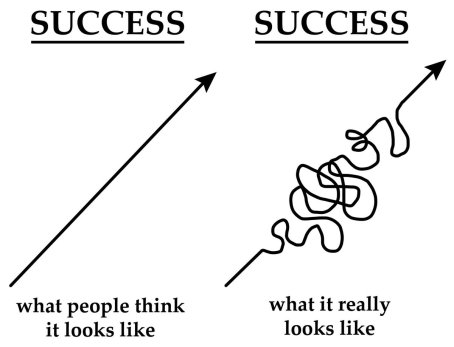
You’ve probably seen this picture of success before. Pursuing your goals might be relatively straightforward, or it might be a twisty-turny choose your own adventure novel. The important part is that you trust the decisions you make enough to commit to them and keep stepping forward.


Why I Keep Training

Running – or training to be precise – can sometimes feel like an unbalanced or unfair relationship. You do your work every day, putting your time and effort and sweat into making your relationship with running better, and then race day comes, and running doesn’t seem to hold up its end of the deal. If you were dating someone and constantly worked on your relationship and did nice things for them, and they didn’t reciprocate, you would probably dump them. So why do I keep training?

I briefly pondered that today. It was a level and logical question – not an emotional one as I’ve been before. I wasn’t upset at myself for wondering, just thought about it as I had an off day today. I rarely take weekdays off, but I finished up my track season last night and am feeling a little beat up from it. Plus, I haven’t had an extended break besides my usual down weeks once a month since January, so this is instrumental in me making it through all of 2017 healthy.

Back to the question of why I keep at it. I’ve thought before that I could back way off on training and still be semi-competitive. I could probably run 20 minute 5ks and maybe bust out a 19:30 on a good day or a fast course. Depending on the level of competition, I could win some age group awards or maybe even the whole female division. I could spend less time on training, not be as tired, and still scratch that running itch.

But I want more.

I don’t want college to be my peak. I don’t want to just PR in the 5k, I want to take a whopping 24 seconds off and one day break 18 minutes. I want to PR in every event from the 400 to the marathon. And all of that takes a lot of work. Until I stop wanting more, it’ll be worth it to inch ever closer to those goals.

I realized with a smile today that these thoughts closely parallel one of my favorite sections of Once a Runner which is the best book written about competitive distance running. The backstory starts with the main character Cassidy (an elite miler) explaining to his girlfriend Andrea how track is different from other sports since the comparisons across time aren’t subjective.

“In track it’s all there in black and white. Lot of people can’t take that kind of pressure; the ego withers in the face of the evidence. We all carry our little credentials around with us; that’s why the numbers are so important to us, why we’re always talking about them.

“…the point is that we know not only whether we are good, bad, or mediocre, but whether we’re first, third, or a hundred and ninety seventh at any given point…assuming we make the lists. That’s right. Sometimes it is possible, despite your best efforts and a hundred miles a week to not even exist. That, my dear, breaks my heart.”

Disclaimer: I am and never was in the same ballpark as Cassidy (a fictional runner but still). I would be one of those people who didn’t make the lists. I describe myself best as a serious runner and/or a competitive runner. Running is a high priority for me, and I typically race around 75% of age graded results, so that’s good enough for me to say competitive. For me, not being at an elite level doesn’t change the fact that I am training toward goals – the same way someone who is trying to run a whole 5k without walking is.

“But you can beat most of the people around, we know that, right? Isn’t that good, isn’t that what you want?”

Here Andrea echos that voice in my head that sometimes tries to convince me that I don’t need to run 50+ miles a week or lift weights or foam roll. If I can do decently well in local road races, isn’t that enough? For people like Cassidy and me, it’s not. His response gets me amped up every time I read it, and typing it tonight was no exception.

“It’s a simple choice: We can all be good boys and wear our letter sweaters around and get our little degrees and find some nice girl to settle, you know, down with…”

“Or what? What is the alternative?

Andrea doesn’t know what’s coming next.

“Or we can blaze! Become legends in our own time, strike fear in the heart of mediocre talent everywhere! We can scald dogs, put records out of reach! Make the stands gasp as we blow into an unearthly kick from three hundred yards out! We can become God’s own messengers delivering the dreaded scrolls! We can race dark Satan himself till he wheezes fiery cinders down the back straightaway! They’ll speak our names in hushed tones, ‘Those guys are animals’ they’ll say! We can lay it on the line, bust a gut, show them a clean pair of heels. We can sprint the turn on a spring breeze and feel the winter leave our feet! We can, by God, let our demons loose and just wail on!”

So that’s why I keep training. I have goals that demand more than mediocrity of me, and I have enough fire in me to put my head down and grit my way through a final kick or another interval rep around the track. Finish times might be black and white, but records are meant to be broken, so while I am in this stage of life – settled, few responsibilities (aka no kiddos), and healthy – I’m going to keep chasing them.


Past Me Would be Proud

I have a joke with one of my friends called “past me would be proud.” Both of us are still pursuing competitive distance running post-college while also balancing jobs and lives in general. It’s hard. In college, it was understood that you carved hours of your day out for practice, not to mention the 24/7 access to the training room and a dining hall full of food you don’t have to cook yourself.

Although I do still have ambitions to run faster than I did in college, I’ve also come up with other goals I can accomplish – chasing soft PRs and celebrating relative successes.

Soft PRs are in events that I didn’t run often in college – the 400, the 800, the 10k, and to an extent, the 3000 – basically anything but a 5k or 6k. I already managed a 10k PR this March, so the spring is for tackling the shorter events. Lucky for me, the Atlanta Track Club hosts All Comers track meets every year in May and June where I have the opportunity to take on some of these events without pressure (or embarrassing myself).

The first event I ran this year was the 400. I sadly didn’t get a PR (under 1:08) as I ran 1:09 which is what I almost always run the 400 in. It is hilariously predictable. If you need someone who can heal-strike their way to a 1:09, I’m your girl.

Last night I took on the 800. I had my eye on a PR and hopefully a sub-2:30. I ran it last year and managed to tie my PR (2:32), so I was excited to see what I could do this year with a goal in mind. The 800 is a strange and incredibly painful event, and I grimaced my way to a slight PR (2:31) but no dice on the sub-2:30. There’s always next year!

When I’m out of soft PRs, there’s always relative success. This is where “past me would be proud” comes into play. I’m still faster now than I was in all of high school and the beginning of college, so even if I don’t run a PR, at least I’ve got that going for me. I managed to progress every year as well, so saying “senior in high school me would be proud” is not quite as good as “sophomore year college would be proud.”

There’s something to be said for consistency as well. I feel like I’ve been stuck in between sophomore and junior year college for a while now, and when I read this quote in Runner’s World a few months ago, it stood out to me. I don’t even remember who it’s from!

“My times were nothing special in high school. I read an interview with Deena Kastor in which she talked about being consistent and believing that results will come over time. I just had this feeling that I had untapped potential and if I stuck with it, I could be successful.”

Even though I haven’t PRed in the 5k since college, I haven’t gotten slower, and there’s something to be said for all of those miles and workouts and races. I also ran under 19:50 for a 5k tempo twice in the last 2 weeks when 2 years ago I fell apart during a 5k race and ran 19:56. To run faster in a workout than I have in a race always feels really good. Plus, high school me would have killed to run under 20. 😉

PSA: Don’t Honk at Runners

There are many uncomfortable things that can happen while you’re out running – needing to use the bathroom, chafing, the weather being miserable, etc. not to mention the outside influences like getting honked or yelled at. I consider honking to among the worst.

The definition of running is that both feet leave the ground during your stride. This is the differentiation between walking and running. Meet officials at race walking events are constantly scrutinizing the stride of the competitors to make sure they always have one foot on the ground. So – while you’re running – there is a moment where your entire body is suspended in the air for each stride. Unless you’re purposefully bounding, you probably don’t even notice this.

You immediately notice when you get honked at, though. Imagine going from a casual stride to a jolted painful one. That’s what getting startled in mid-air does to your form. I’m not expecting to be honked at. All of the other drivers have managed to drive past without honking, so I expect that pattern of behavior to hold.

When someone honks at me, it feels like every muscle in my body contracts simultaneously for a split second. It’s impossible for me to continue running smoothly once I land for my next stride, and the jolt of adrenaline speeds up my heart rate and makes me more out of breath than I already am. Multiple honks are even worse. Even though the shock/jolt lessens with each one, it’s still like being zapped over and over.

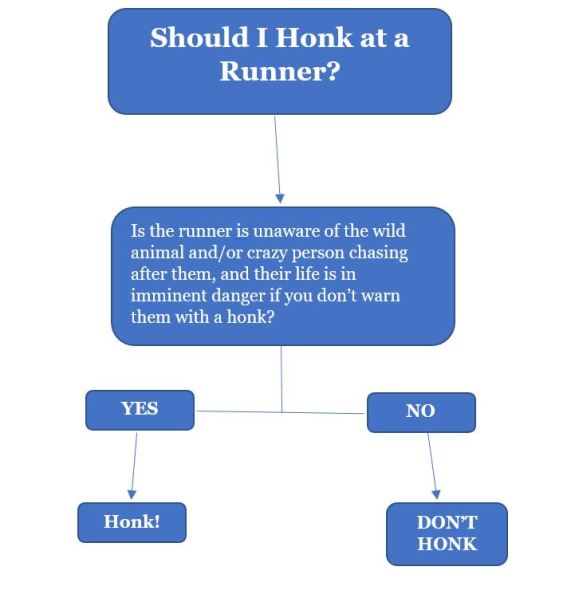
To know when it’s acceptable to honk at a runner, I made this helpful chart.


12 is the Best Number for Workouts

As I warmed up for my 12×300 track workout this morning, a thought popped into my head I’ve had many times: 12 is the best number of reps for a workout.

Almost every rep is a new, generally recognizable fraction. Rep 3 (1/4), 4 (1/3), 6 (1/2), 8 (2/3), and 9 (3/4) all bring a new milestone. You really shouldn’t need a milestone for your first or second rep, and once you hit the 10th rep, you only have “one more ‘til one more.” Then you finish the 11th and let the elation of the “last one” carry you to the end of 12.

Working out with a team in college meant workouts full of comradery. There’s something about suffering together that forms solid bonds of sweaty friendship. The phrase “one more ‘til one more” came from that group of girls, and we used to sing (between gasping breaths) Bon Jovi’s “Livin’ on a Prayer” once we reached the halfway point.

Now that my workouts are solo, I use fractions and other internal motivations. But sometimes, all you can focus on is the interval you are currently running. There’s a great passage in Once a Runner where Cassidy is running a terribly difficult workout (I don’t want to spoil it for you) and talks about focusing on one rep at a time – to slay it and then it’s brother after, over and over. There are times when it’s rough early – when you’re struggling much earlier than expected – and you have so far to go. If I can only focus on the rep at hand, I use rhymes.

One is for fun.
Two is for you.
Three is for free.
Four is a lore.
Five I’m alive.
Six is for kicks.
Seven I’m in heaven.
Eight is great.
Nine is mine.
Ten is (almost) the end.

Sometimes – everything goes well, and the rhymes are just for fun. Those are the best days.

Oh – and one more reason 12 is the best number? This guy wears it.