Women’s Elite Field for Boston 2018

I encountered a Twitter storm Monday afternoon as the Boston Athletic Association announced the elite field for the 2018 Boston Marathon. My (biased) opinion is that US women marathoners are the most exciting segment of distance running right now, so I wanted to take a closer look at just how stacked this field is.

Shalane Flanagan 

Fresh off her first major marathon win in New York, Flanagan decided she wasn’t quite ready to retire yet and is making a run for another major title. The Boston native has always had her eyes on a win in the hometown marathon and would certainly be the cherry on top of a successful career before retirement.

Fun fact: “Every single one of her training partners — 11 women in total — has made it to the Olympics while training with her, an extraordinary feat. Call it the Shalane Effect: You serve as a rocket booster for the careers of the women who work alongside you, while catapulting forward yourself.” Read more here.

PR: 2:21:14


Sara Hall 

Hall is also fresh off a win. With a solo effort for the vast majority of the race, Hall dominated the field at the USATF Marathon Championships earlier this month, running just a few seconds off a PR that she set five weeks prior. Coached by her husband, American Marathon Record-holder Ryan Hall, Sara is definitely coming into form for the marathon after moving up to the distance a few years ago.

PR: 2:27:21


Desi Linden

Desi holds the best finish at a past Boston Marathon when she was 2nd in 2011. Linden is one of my favorite marathoners to watch as she is a complete metronome. During the 2016 US Marathon Trials, her consistency awarded her a 2nd place finish after she didn’t chase the breakaway that Flanagan and Cragg made earlier in the race.

PR: 2:22:38


Molly Huddle

Molly is the American Record-holder in the 10k from the 2016 Olympics (which I cried while watching) where her breakout performance was redemption from her missing out on a medal at the World Championships the year prior.

The marathon is relatively new to Huddle as Boston will be her second marathon after her debut last November. She’s no stranger to success on the roads, and I’m excited to watch her make the transition into the longer distance.

PR: 2:28:13


Jordan Hasay

Jordan is the most exciting new(ish) addition to the American women marathoners. Hassay’s Boston debut last year was the fastest marathon debut of any American woman by nearly 3 minutes. She followed up on that performance with a blazing 2:20:57 at Chicago this fall, putting her at #2 on the list of American female marathoners.

From watching Hassay run the 1500 meter Olympic trials as a high schooler to competing for the dominant Oregon Ducks in college to having some injury struggles post-college, it’s satisfying to watch her find her stride again in the longer distances.

PR: 2:20:57


Serena Burla

Full disclosure, I didn’t know anything about Serena Burla except recognizing her name as an elite runner. As it turns out, she has an incredible story! She’s a cancer survivor, and a surgery in 2011 to remove the cancer also took half of her hamstring. She underwent surgery again in August after finding another malignant tumor in her leg.

PR: 2:26:53


Kellyn Taylor

Kellyn Taylor was another name that was familiar, but I had to look up some details on her. She’s a total badass – pro runner, firefighter, mom, etc. Taylor came excruciatingly close to qualifying for the Olympic team in 2016, finishing 6th at the marathon trials and then 4th in the 10,000 meters.

PR: 2:28:40


Deena Kastor

I saved the queen for last. Kastor is the American record holder in the marathon, half marathon among other accolades. She has an Olympic bronze in the marathon from 2004 and broke the Master’s marathon record by nearly a minute in 2015, running 2:27:47. She’ll be 45 at the 2018 Boston Marathon and will still be running away from much of the competition.

PR: 2:19:36


Boston 2018 – I can’t wait to watch! Could this be the first year since 1985 that an American takes home the crown?

One Year at Praxis

A little over a year ago today. Isaac Morehouse turned my life upside down by sending me an email: “Got ten minutes for a quick phone call?” That quick phone call led to me giving notice at my job – my first job out of college where I had been for 4.5 years – and embarking on the new adventure of working for Praxis. Here are some of my favorite memories from the last 12 months:

November

I dove straight in by getting to know the product better, getting to know the team better, and getting caught up on the implementation of Salesforce and Hubspot. I found Hubspot to be very intimidating since I had never worked with a marketing automaton software before but I quickly became a fan. Anything that gives you stalker level data (page views, email opens, etc) is fascinating to me.

December

My first trip to Charleston! I witnessed a Ceterus vs. Praxis basketball game and burned more calories from laughing than I would have if I played myself.

I got to meet some team members in person, and Isaac asked me to do a presentation on Salesforce for everyone. I was extremely nervous for this (funny looking back how nervous I was about literally everything), but it went well! I love Salesforce, and talking about something you love and use for 90% of your job is fun, not scary.

January

January was an exciting month because it was a fresh start in terms of data for the year. Since we got Salesforce in November, I spent 2 months importing and organizing all of the past customer/applicant data. When you import hundreds of new leads one week, it kind of throws off your lead capture tracking! January marked a month where all of that was finally over, and we could have consistent metrics going forward.

January was a lot of dashboard building. I had experience building reports at my old job but never dashboards, so that was a new project to tackle. Having visual representations of our data is incredibly useful for team members who want the “at-a-glance” summary of what’s going on.

February

February had a very memorable phone call. Accepted applicants typically set up a time to talk with me about tuition questions or start date questions while they’re making their decision. An applicant scheduled a call with me and let me know his dad was joining the call. I had never spoken with a parent before and immediately feared the worst – he was going to think we were a scam or not the right path for his son (aka not college), and he was going to take out his doubts and frustrations on me.

In reality, the call was fantastic. Yes, they both had some logistical questions, but the dad was on board and a huge fan. He was one of those parents who say, “I wish this had been around when I was younger!” I left that call feeling on top of the world.

March

March was a crazy month for the team because Isaac went on Fox Business News, and our website traffic (and every other metric) blew up. Everyone on the team went into recon mode, and we were working around the clock to keep up with all of the emails and calls and applications. It was managed chaos that had moments of stress but was mostly a blast – that sweet spot of having a full (and interesting) plate without being detrimentally overwhelmed.

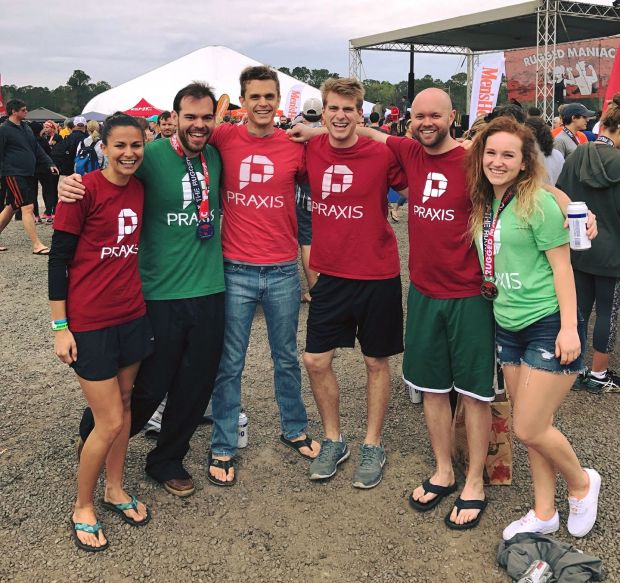
March was also our second team get together in Charleston! This trip was centered around a Rugged Maniac race – a 5k course with 25 obstacles along the way. Some of us enjoyed it more than others.

April

I started this blog! Since our participants build a website and blog for 30 days during the bootcamp portion of the program, I thought it was probably time for me to get on board and tackle the challenge on my own. My coworker Chuck built my website and I got up 30 blog posts over the next month.

I kept telling myself April was a terrible time to start since we bought a new house, did a week’s worth of renovations, sold our old house, and moved during that month, but it actually provided some good material for writing.

May

May started our first discussions on upgrading our Salesforce from Professional to Enterprise level. I visited the Salesforce office in Buckhead and had a meeting with our account’s team, and then we had many, many meetings over the course of the month. While I was eager to get the functionality of workflows back in my life, in the end we weren’t able to justify the huge jump in cost (for now – keep reading!). It was a good exercise for me to quantify the benefits rather than just be excited about “all the cool things we could do!”

June

In June I created my first custom object in Salesforce! With our program growing, it became more important to have an accessible record of what all of the participants are up to. I created a simple object where advisors can log their notes as well as the advising session date, so we could track sessions by date. I also had to make a new user profile for advisor permissions – more new territory in customizing Salesforce.

June is also when FEEcon happened! It was a fun mix of my past FEEple and current Praxians, and it was the first time I met many of our participants and alumni in person.

July

I further delved into the customization of Salesforce and built my second custom object. Our participants complete deliverables each month, and I worked with Chuck to make the submission forms and mapped all of the information into the new Deliverable object in Salesforce. Since each deliverable has different fields, I made a different page layout for each deliverable record type and then created a report to show participants with and without deliverables, so our Education team can easily see who has submitted what.

When your job doesn’t consistently create a tangible product in the same way a carpenter or a painter does, it’s incredibly fulfilling to build something new.

August

Praxis came to Atlanta! We had about 70 participants, alumni, advisors, and staff gather downtown for a Praxis Weekend. I gave a talk for the first time in my life (not counting being a moderator or running an activity) and enjoyed meeting people in real life as opposed to conversing over chat or email.

We also made a huge change in August: we switched our marketing from Hubspot to a mix of Salesforce (upgrading to Enterprise, reuniting me with my one true love – workflows) and MailChimp. We had to remake our entire marketing and sales funnel by the end of August before Hubspot turned off on September 1st. Chuck, Brian, and Derek flew to Atlanta and stayed at my house, so we could grind through the 12+ hour days together. I was insanely excited to move to Enterprise and work with Salesforce workflows, but there were certainly some frustrations along the way (like how formula fields and workflows can’t kick off other workflows and how annoying it is to design HTML emails inside Salesforce). We made the deadline, though, and successfully transitioned into a new marketing funnel and application process.

September

The beginning of September was juggling practice as I had August applicants in the old application process who needed certain emails manually and September applicants in the new application process who were in automated workflows. It all worked out fine, but I was counting down the days until everyone was successfully transitioned to the new system!

October

I started advising sessions with participants! I’ve been interviewing applicants since I began working at Praxis but have had little involvement in the education experience. Isaac asked all staff to be open to advising sessions, so I set up my calendar and got a booking! Even though I was nervous about the new territory, all of my sessions so far have been a blast. I leave the sessions with energy and excitement for what the participants can accomplish. #thePraxianeffect


It’s been an awesome year, and I can’t wait for what’s next! Here’s to 2018.

Breaking Out of a Broken System Review: Part 2

Recap: The book is split in half – the first half on black paper/white text from Seth’s perspective and the second half on white paper/black text from Chandler’s perspective. I reviewed Seth’s half here.


PROS:

Considering the long break between my reading the first half and the second half, diving into Chandler’s section was like a breath of fresh air. It’s always exciting to see ideas I consider to be “Praxian” out in the real world. Chandler begins by talking about the scarcity mindset versus the abundance mindset and how winners adapt the abundance mindset. Plus, life is just more enjoyable when you don’t live life believing the pie is fixed and you have to fight for your piece.

I also appreciate his chapter on “unlocking your inner five-year-old” talking about how children can often accomplish great things because they haven’t yet learned that they aren’t “supposed to” be able to do that. It reminded me a lot of running cross country my freshman year of high school before I became a super competitive stalker of my competition. I would just go run races and do pretty well and be happy about it. The ignorance was blissful, and it became much harder to race when I started looking up the times other girls were running and finding who I “should” and “shouldn’t” be able to keep up with. (Luckily, I learned to use my research for good and haven’t been a complete headcase since then.)

The biggest difference between the two half is that Chandler invites the reader to interact with the book and had questions with space for answers in each section. Full disclosure, I did not participate or write in the book, but I think it could be really helpful, especially to a reader who is encountering these ideas for the first time.

I found myself agreeing and zipping through the second half of the book. Chandler writes about the same lessons as Seth but with his own personal touch, so it felt very familiar without being too repetitive. Chandler is also a proponent of starting your own business and offers similar advice regarding the tax advantages as Seth does without disparaging work if it’s “for someone else.” Some other highlights include:

  • Having the strongest work ethic (but really, not just saying you do)
  • Having a good attitude about your work
  • Being efficient to work smart (basically doubling your work ethic)
  • Setting SMART goals
  • Having a proactive mindset instead of a reactive mindset (like this post!)
  • Not being complacent after meeting a goal – set a new one!
  • Learning “the rules” about money


CONS:

Similar to Seth’s half, I wished there was more information on Chandler’s story and how he got to where he is today. He mentions having a lawncare business while in high school and then working for Student Painters and having a lot of success through that, but I found myself wanting more details.

Timing is also an issue since Breaking out of a Broken System was published in 2014. Chandler started his business Self-Publishing School that same year (not sure which came first) and has published 6 books to date. These are things I found myself wanting to know more about when reading his chapters until I checked the publication date on the book. I’m sure I can find the story in one of his five other books, though.

Finally, Chandler has a Yahoo email address. This is mainly a joke since at Praxis we strongly suggest Gmail addresses to our participants. Our CEO says Yahoo, Hotmail, AOL, etc. all send the message, “old, outdated, and behind the times,” so seeing the Yahoo address made me laugh.


Overall I would definitely recommend the book. Any of the cons about the book are either me wanting more details or something that I disagree with but is written with good/pure intentions. I also recommend the band NEEDTOBREATHE if you want to hear Seth play the bass! 🙂


Just Google It: Panel Graphs in Excel

I got a data task last week. I love my data. At my last job I once got lost writing a report on our evaluation data and didn’t look up from my computer until my stomach growled and I realized I stayed an hour later than I usually go home.

Anyway, I had the task of plotting some pretty disparate numbers. Things like website traffic (maximum at tens of thousands) per week as well as acceptances (maximum under 10) per week…plus some numbers in between. I thought this would be easily solvable with a secondary Y axis but after plotting the data that way, I realized it wasn’t the best solution. I either needed to blow up the graph to billboard size or have a third or fourth Y axis to make it work.

Then I tried taking out website traffic as a whole since it was the outlier, but then my next biggest variable became a problem since it was an outlier compared to the rest of my data. My next solution was to plot all of the variables separtely. Since the data is all plotted by week, I just had to stack them on top of each other, and the trends (spikes and dips) would still show even though it wouldn’t be as visually appealing. I made all 5 graphs before realizing that was a dumb idea. Frustrated, I told myself that there are entire professions based around data analysis and visualization, and there has to be a way to display these numbers in the same graph.

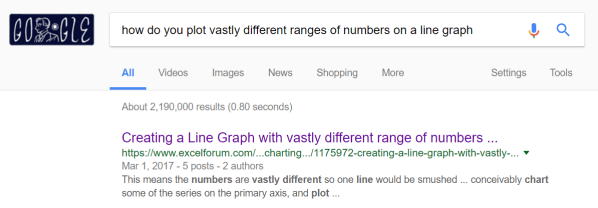
I then turned to my best friend, Google. I can remember taking a computer applications class in middle school where we learned the “proper” way to search – using keywords, plus signs, etc. That is never the way I search, though. I’m a fan of typing full sentences or phrases of my stream of consciousness. In the pre-Shazam or Siri days, I found many a song title and artist by typing in the lyrics of songs I heard on the radio.

This is what I typed in, and I felt it like destiny that someone else had used the same phrase that I had. The forum led me here which is where I found my answer.

The feeling of fate continued as I read the post. The writer laid out all of the ways people attempt to display data like this, which mirrored the attempts I had just made.

  • You can plot everything on the same graph with one Y axis, but that leads to everything but your outlier looking like a flat line.
  • You can plot a second Y axis, but then you have to remember which lines go with which axis (and still wasn’t enough in my case)
  • You can plot all of the data on separate charts and try to line up the X axis

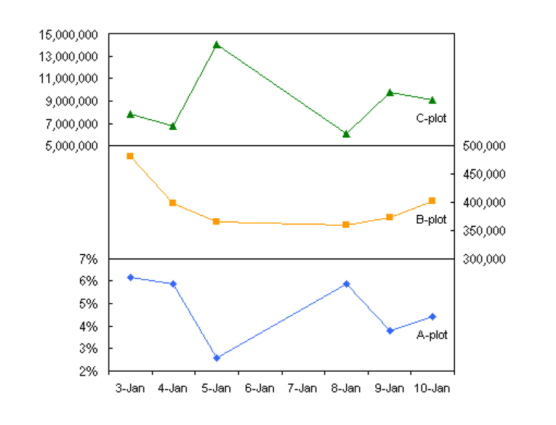
Or you can make a panel graph! I copied the format of the data and the formulas in the step by step instructions (accounting for the fact that I needed 5 panels rather than 3). Since the example data is so small compared to mine, I had to write down a list of conversions (example E9 = my G44) to get the formulas right after quite a few mistakes that had my graph looking wonky. But then I had it! Five variables worth of data aligned along the same X axis each with its own Y axis for scale.

The point of all of this is that it’s very unlikely that the problem you’re experiencing is something only you will encounter. The internet is a wonderful place that can help you with many problems from fixing your blender (boil the blade kit to get it unstuck) or helping you make a panel graph for the first time.


Breaking Out of a Broken System Review: Part 1

I learned about the band NEEDTOBREATHE my first summer working at Strong Rock Camp when my co-counselor would play their music to wake our girls up in the morning. I had the opportunity to see them play live at a Braves game this summer which led me to Googling the different band members after the concert to learn their story.

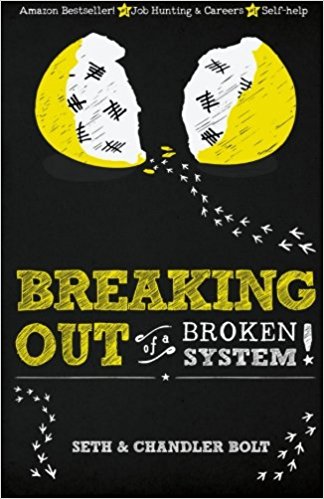
I found that the bassist Seth Bolt opened a recording studio at age 16 and wrote a book with his brother Chandler (who also was a young entrepreneur) called Breaking Out of a Broken System. It sounded interesting, so I got a copy.

The book is split in half – the first half on black paper/white text from Seth’s perspective and the second half on white paper/black text from Chandler’s perspective. I finished Seth’s half and wanted to share my thoughts so far.


PROS:

The way they wrote the book is impressive. Since they have such busy schedules, they planned to write the entire book over a 7-day period. They use timers to strictly finish a chapter within 2 hours: 10 minute brainstorm/10 minute outline/90 minutes of writing/10 minute break. Repeat. There’s a whole chapter on how perfectionism is the enemy of getting stuff done and how to avoid analysis paralysis.

I appreciated the purpose of work near the beginning of the book. Seth talks about how God gave Adam the task of caring for the garden and the animals, so humans working and having a purpose existed before the fall. Many people think of work as punishment for sin, but it’s not! And it is certainly easier to think about work being purposeful than a penalty.

The “you do you” chapter was great as well. That’s not what it’s called, but I like that umbrella term for it It’s a combination of forging your own path and not needing to “keep up with the Joneses.” I especially liked when Seth talked about how it is important for children to see their parents pursuing dreams rather than giving up everything to focus on their children. While I don’t have my own children, I did grow up with parents who provided everything I needed while also not allowing my sister or me think we were the center of their universe.

The end of Seth’s half is the best part. He talks about saving his allowance and construction money to buy his first guitar and continuing to save up until he had enough recording equipment to launch his studio business at 16. I really wish this section were more detailed because I would have loved to hear how he got those first clients and any struggles he encountered as a young entrepreneur.

He’s a huge proponent of owning your own business and talks about plowing the money you make back into your business to grow it, thereby making it a deduction on your taxes rather than taxable profit. It made me laugh that he even included the disclaimer “this is legal.” Not only does he explain the rules of the tax code, he also provides a list of the paperwork you need to fill out to start a business. It’s a quick action plan that leaves no room for excuses, especially paired with the previous chapters.

Overall I really like the book. I found a lot of similarities between the lessons my parents taught me growing up and the lessons their parents taught them. I think the lessons will be especially valuable to someone who is hearing it for the first time. I also loved the old family photos and stick figure drawings throughout the chapters.

CONS:

I almost lost my mind over Chapter 8. Seth talks about how companies should make benevolence and philanthropy a main focus and not be so concerned with profits. It’s a very typical misunderstanding of business – thinking that profit is bad and charity is good. What this black and white stance misses is the value created from that profit. People willingly give their money to companies for goods and services that make their lives better. Profits don’t come from scamming customers or ripping them off; they come benefiting customers.

Then he uses TOMS shoes as his example of a company who is doing things the right way. In my mind, TOMS is the absolute worst offender of “good intentions, terrible results.” I’m going to spare you my rant because all you need to do is type “TOMS shoes are the worst” into Google, and you’ll get plenty of reading material. For a fuller picture, you should watch the documentary Poverty, Inc. It’s on Netflix. You’re welcome.

The beginning of Chapter 15 reminded me of so many articles I find on the internet that are “Praxis-adjacent” as I like to call them. The author realizes that something is broken – college tuition is way too expensive, and college grads aren’t getting jobs – but then ends up concluding that using the broken system is still needed. Seth even goes as far to say, “The public education system was designed during the industrial revolution to produce loyal, faithful workers. It was designed to serve industrialism.” But then follows a few pages later with, “The system’s motto is ‘Go to school, get a job.’ You need to think: ‘Go to school, create a job.’” It’s just funny to me that he includes school in his category of a broken system and then still has it as a pre-requisite for creating the life you want for yourself.

The end of Chapter 15 just made me sad. It is full of Pros (above), but positioning working for someone else (anything other than owning your own business) as “exchanging time for money” is so wrong. Companies don’t pay you for your time, and if you view your work that way, it sounds like you are a clock-watcher, and I’m sorry you hate your job so much. The work you do should be creating value for the company you work for and its customers, and you are paid in exchange for creating that value. Your time in and of itself is not what your employer pays you for – it’s what you do with that time.

Overall I thought Seth’s advice skimmed the surface of a lot of great points and missed the opportunity to really flesh out the ideas and give them some depth. I think this has a lot to do with my exposure to Praxis and its content which, in my opinion, is much better. 😉 I think the time constraints (2 hours per chapter, finished manuscript in 7 days) had a lot to do with the lack of depth and am still very impressed with the book as a whole.


Looking forward to part 2 and hearing from Seth’s younger brother Chandler about his entrepreneurial endeavors!

Decide, Commit, Step Forward: How to Break Free from FOMO and Organize your Ambition

When I first started at Praxis, I learned that it is something I’ll always have to explain to people. The follow up question is usually about our participants who I like to describe as “exhaustingly inspiring.” Our community is constantly pinging with notifications about new websites, new blog posts, new projects, new group discussions, podcast, reading groups, etc. It’s overwhelming in the best sense of the word.

But that feeling of being overwhelmed can also be detrimental. It can cause analysis paralysis and make you not know where to start or spark 1 million half-baked ideas that you never put into action because you don’t want to give up on thinking of 1 million more ideas. We see this when people are afraid to commit to a single project idea because they don’t know if it’s the “right” one. You can experience, fear, anxiety, regret, and FOMO (fear of missing out) when you’re negatively overwhelmed, and I’m going to address how to overcome that.

First, I want to start with a little economics. Economics was my first love from when my dad was my econ teacher in high school and that led me to pick econ as my major in college and then to FEE (Foundation for Economic Education) for my first 5 years out of school. I sincerely think that economics is the single most useful subject to know and understand to function successfully in the world. One of the taglines we used when marketing FEE programs was “see the world more clearly” because looking at events through an economic lens gives you understanding and clarity.

One of the basics of economics is opportunity cost. This is a concept most people understand even if they don’t know the formal name for it. Opportunity cost is defined as the value of your next best alternative. Textbook examples usually include something like, “Sally can go to the movies with her friends or go to the baseball game with her family. Whichever thing she doesn’t choose is her opportunity cost.”

Easy, right? Everyone gets that you can only do one thing at a time, but the actual cost of what you’re giving up can sometimes be overestimated. Since you can only do one thing at a time, opportunity cost is only the value of your next best alternative, not the sum of all of the values of literally every other thing you could be doing. Choosing option A doesn’t mean your cost is B and C and D and E (and…etc); the cost is just B (assuming it’s your next best choice) because if you choose B, that precludes you from choosing the others as well.

I explain all of that to emphasize the importance of knowing the true cost of your decisions. Thinking in the flawed way of, “I’m losing out on every single other thing!” rather than only giving up the next best choice can cause major analysis paralysis. It can put more pressure than is needed on making the “right” choice because you believe the stakes are higher than they really are.

Acknowledge the opportunity cost of your decisions, and use that information to help you make the best choice.

Another note on decisions: everything is a choice. Even refusing to make a decision is a decision in and of itself. You won’t get the time back you spent deliberating or agonizing over a choice, so keep opportunity cost in mind when it comes to how much time you spend making a decision. Not every decision needs a well-constructed argument or research to back it up. For instance, I spent a few hours researching, comparing models, reading reviews, and even going to a store to look at the sizes/feel the weights when I was picking out a new laptop last year. It was a larger purchase and important purchase, so I wanted to make a good decision. I wouldn’t spend that amount of time on buying a new toaster or waffle maker. It’s just not worth my time!

That’s a simplified example, but as someone who is prone to getting sucked into reading Amazon reviews, it’s important to take a clarifying moment to judge the priority of a decision. I’m not trying to encourage rash decision making, but not every decision needs a pro-con list. Some things aren’t worth it. In fact, most aren’t.

Ranking the priority of your decisions is important because decision fatigue is a real thing. People who make more decisions throughout the day struggle with self-control and will power at the end of the day, more so than those who make fewer decisions. Interestingly, it’s also shown that judges make “less favorable” decisions later in the day than they do in the morning. (Something to keep in mind if you’re ever in court and able to pick the time of your appointment.) Another example is Mark Zuckerberg, who has been quoted as saying that’s why he wears jeans and a grey Tshirt every day. He doesn’t want to waste the mental capacity on deciding what to wear when he could use that capacity to further take over the world with Facebook.

That’s why I named the first part of this post decide. It’s important to know how to make a decision. And after you make it – commit to it. There are no time machines. So – when you make a decision, commit to it and only look forward. Thinking about what you “woulda coulda shoulda” done is a waste of your time, and regret is not a productive emotion.

I loved the Forward Tilt episode “Living with Integrity.” I excitedly slacked Isaac the morning it came out telling him it had so much in common with what I wanted to talk about at Praxis Weekend. My favorite (hypothetical) example is when he talks about his wife asking him to attend a social event that he doesn’t necessarily want to go to. He says the option that shows integrity isn’t so much about whether he decides to go or not but about his commitment to that decision. A lack of integrity would be agreeing to go to the party and then acting pouty and passive aggressive about being there, possibly ruining the outing for his wife. If you decide to go – go and be just as a pleasant human being as you would have if you stayed home.  You can’t keep one foot in your decision – it requires both feet.

I want to clarify this doesn’t mean you never change your mind or pivot away from an original decision or goal. You absolutely should do that in some cases. How you decide to do that involves thinking about how that new decision changes your next step. Another economic concept that’s important to understand is sunk cost. A sunk cost is one you’ve already paid – either with time or money or resources. My favorite example is all you can eat buffets.

If you go to a buffet and pay $25 at the door, you can’t get that money back no matter how much or how little you eat. Eating more to “get your money’s worth” is an illogical argument, and you should only base your decision to get another plate of food on if you think it will make you feel happier (do it!) or sick (don’t do it).

So yes, past information is helpful when making current decisions, but you base your decision on how it will affect your future – looking forward. When I was coming up with the outline for this post, I pictured it as describing life as a choose your own adventure book. At the end of each chapter, you have to pick which way to go, commit to that decision by turning to the correct page, and then step forward by starting your new chapter. Then repeat.

Continuing with that example, some chapters are longer than others. Praxis curriculum is built around 30-day PDPs (personal development projects), and you have the freedom to learn a different skill every month or spend 3, 6, etc months building on a single skill. Devoting a month to something is a great, low-risk way to test if you want to pursue it further. If you dedicate a month to learning guitar and find that music isn’t your thing, it’s not a big deal! You learned something about yourself and can adjust accordingly for your future goals and learning.

It’s up to you to determine which activities and goals to pursue further and which to give up through honest self-assessment. Grinding through something you don’t always like or doesn’t “feel” fulfilling is important if it moves you toward bigger goals, but grinding for the sake of grinding is not and is a waste of your time.

Now that we’ve discussed the proper framework for good decision making, here are my tips for “organizing your ambition.” I will use my favorite example from my own life – running.

  1. Pick a goal

Here I’m talking about your long-term goals, not something you want to accomplish in 30 days. This should be something difficult that you might spend years of your life inching toward. SMART goals are important, so make sure you strike a balance between challenging and realistic. For instance, my goal doesn’t have to do with running at the Olympic level because that is hilariously unrealistic.

But my goal is challenging. It’s to break 18 minutes for 5k. I’ve been working on getting faster technically since I was 12 but seriously toward this goal since I was 19 or 20. I’d like to accomplish it before I have kids, so I have roughly a 10-year deadline.

  1. Document your progress

This is so important in your professional career! If you have a portfolio of projects that demonstrate the value you can create, you immediately set yourself apart from a crowd. You won’t be in the stack of 1,000 other resumes, and you’ll have credibility with an interviewer. Think of the difference between saying, “I build websites and proficient in X coding languages” and saying that plus having examples of the websites and client testimonials.

Having documentation also allows you to see the progress you make toward your goal. I’ve kept an online running log since 2007, so I have over 10 years of data to look back on. The documentation is also helpful for when I need an expert’s advice, which leads to my next point.

  1. Get a coach

Remember decision fatigue from earlier? It will be much more taxing both mentally and physically if you’re having to teach yourself the basics AND research the best resources AND try to put it all into practice AND get feedback on how you’re doing.

I “coached” myself for about a year out of college. I use the word coached very loosely because I had no idea what I was doing. I mainly looked at my running log from college and would randomly pick workouts and do them. It was hard to know what paces to aim for, and I can remember the pressure of trying to decide what I was going to do the next morning before I went to bed.

I finally asked one of my teammates from college who was coaching if he would take me on, and he did. Not only did my decision fatigue decrease, but there’s also something really helpful about having someone else challenge you and believe in you. You get an extra bump from the external motivation because your coach isn’t going to purposely set you up to fail. If you have a hard workout assigned, you get the boost of confidence from knowing, “He thinks I can do this.”

Sometimes you need the kick in the butt form of external motivation as well. This story isn’t my own, it’s from a runner friend who posted it on Facebook. She went to see a PT who asked her if she had been doing her exercises and stretches and foam rolling. Her answer was some form of “not as much as I should.” His answer sticks with me today.

“Oh I’m sorry. I thought you wanted to be fast.”

It sounds really harsh, but it has motivated me countless times since I heard it. You see, running is the easy part of training. The hard parts of training are lifting weights, stretching, eating right, turning off Netflix to get 8+ hours of sleep, etc. If I’m ever lacking motivation, I sassily say to myself, “Oh, sorry, I thought you wanted to run under 18,” and that helps get me going.

Find a coach. Find someone (or a handful of people) who will be fitness trainers for your goals and career and who will give you the kick in the butt when you need it and who will celebrate with you when you meet your goal.

  1. Be unapologetic about your goals.

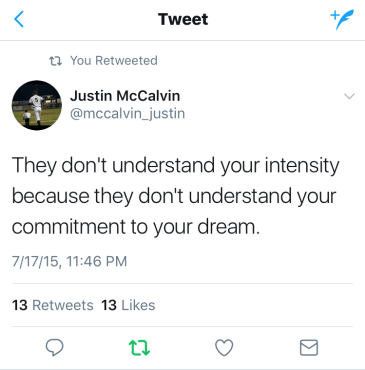
I love this tweet. I have no idea who this guy is, but this tweet stood out enough in my memory for me to scroll through 2 years of my twitter page to find it. I ended up Googling him and found out he’s a baseball player, so the athlete analogies continue.

If you’re a highly-motivated doer, you already know you’re weird. People don’t always understand why you’re so driven or how you get so much done. Sometimes this inability to understand comes out as their own insecurity, so they make fun of you. To that I say, SHAKE OFF THE HATERS. Recognize their negative attention for what it really is – their defensiveness and insecurity about pursuing mediocrity.

I’m definitely not saying to go around having an elitist attitude toward everyone. Sometimes you just have to remind yourself that you’re pursing your goal for YOU and because YOU’RE interested in it. It doesn’t matter what other people think.

  1. Don’t be a martyr.

Another way to be unapologetic about your goals is the more literal sense – don’t apologize. And definitely don’t be a martyr. I’ve been more careful about my language ever since someone pointed out to me that I say “I have to run” rather than “I’m going to run.” There’s a huge difference!

“Having” to do something implies an obligation that wasn’t made by you and is something out of your control. Using that language also allows you to play the martyr card. Instead of being unapologetic and unashamed of your goal, you treat it like a burden.

“Oh sorry – I can’t stay out. I have to get up at 6am to run.”

What you’re really saying is, “please give me sympathy for this choice that is 100% mine and I normally don’t complain about.”

Don’t be that person.

  1. Get a community

You have likely heard that you’re the average of the five people you spend the most time with and that your external environment shapes you. If you want to achieve a goal, especially a tough goal, you need to surround yourself with positive people who believe you can do it and, most importantly, who have goals of their own.

To use a phrase from the Bible, don’t be around those who are stumbling blocks to you, those who impede your progress or sabotage your work.

This is what is so great about the Praxis Community and why its members are “exhaustingly inspiring.” It is a group of 200+ people who are all talented and creating/doing/learning every day. No, they aren’t all supernatural geniuses who never succumb to resistance or doubt themselves, but they are definitely a biased sample size of humanity.

Find your tribe.

  1. There is no Secret

This, like opportunity cost, is something that people often say they believe but don’t live like they believe it. I love illustrating this through a quote from the book Once a Runner. The backstory is that there’s an Olympic gold medalist in the 5000 who lives in town. Various people join his training group, but only on rare occasion does anyone stick with it for longer than a few weeks. They’re drawn to him because they want to know The Secret, as if they can pick up on it just from being around him.

What was the secret, they wanted to know; in a thousand different ways they wanted to know The Secret. And not one of them was prepared, truly prepared to believe that it had not so much to do with chemicals and zippy mental tricks as with that most unprofound and sometimes heart-rending process of removing, molecule by molecule, the very tough rubber that comprised the bottoms of his training shoes. The Trial of Miles; Miles of Trials.

The secret is there is no secret. There’s no magic pill to make you smarter, more athletic, or better looking. There’s no secret subject line that will make your video go viral. It’s about hard work. It’s about grinding. It’s about your commitment being so strong that you can’t be deterred by distractions or haters. It’s about aligning your incentives, your habits, and your schedule around your work so that a weird day or a lack of motivation is just a blip on the radar rather than a tidal wave that throws you off balance. It’s about doing all of the behind the scenes work that you don’t get any glory for.

It’s about doing at least one small thing to work toward your goal every.damn.day.
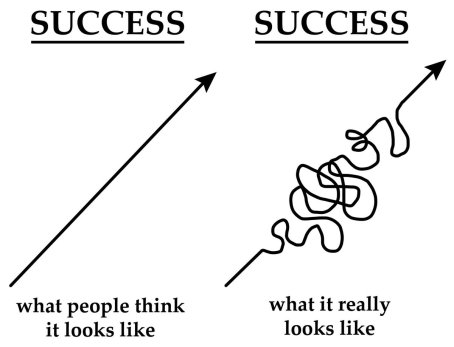
You’ve probably seen this picture of success before. Pursuing your goals might be relatively straightforward, or it might be a twisty-turny choose your own adventure novel. The important part is that you trust the decisions you make enough to commit to them and keep stepping forward.


Why I Keep Training

Running – or training to be precise – can sometimes feel like an unbalanced or unfair relationship. You do your work every day, putting your time and effort and sweat into making your relationship with running better, and then race day comes, and running doesn’t seem to hold up its end of the deal. If you were dating someone and constantly worked on your relationship and did nice things for them, and they didn’t reciprocate, you would probably dump them. So why do I keep training?

I briefly pondered that today. It was a level and logical question – not an emotional one as I’ve been before. I wasn’t upset at myself for wondering, just thought about it as I had an off day today. I rarely take weekdays off, but I finished up my track season last night and am feeling a little beat up from it. Plus, I haven’t had an extended break besides my usual down weeks once a month since January, so this is instrumental in me making it through all of 2017 healthy.

Back to the question of why I keep at it. I’ve thought before that I could back way off on training and still be semi-competitive. I could probably run 20 minute 5ks and maybe bust out a 19:30 on a good day or a fast course. Depending on the level of competition, I could win some age group awards or maybe even the whole female division. I could spend less time on training, not be as tired, and still scratch that running itch.

But I want more.

I don’t want college to be my peak. I don’t want to just PR in the 5k, I want to take a whopping 24 seconds off and one day break 18 minutes. I want to PR in every event from the 400 to the marathon. And all of that takes a lot of work. Until I stop wanting more, it’ll be worth it to inch ever closer to those goals.

I realized with a smile today that these thoughts closely parallel one of my favorite sections of Once a Runner which is the best book written about competitive distance running. The backstory starts with the main character Cassidy (an elite miler) explaining to his girlfriend Andrea how track is different from other sports since the comparisons across time aren’t subjective.

“In track it’s all there in black and white. Lot of people can’t take that kind of pressure; the ego withers in the face of the evidence. We all carry our little credentials around with us; that’s why the numbers are so important to us, why we’re always talking about them.

“…the point is that we know not only whether we are good, bad, or mediocre, but whether we’re first, third, or a hundred and ninety seventh at any given point…assuming we make the lists. That’s right. Sometimes it is possible, despite your best efforts and a hundred miles a week to not even exist. That, my dear, breaks my heart.”

Disclaimer: I am and never was in the same ballpark as Cassidy (a fictional runner but still). I would be one of those people who didn’t make the lists. I describe myself best as a serious runner and/or a competitive runner. Running is a high priority for me, and I typically race around 75% of age graded results, so that’s good enough for me to say competitive. For me, not being at an elite level doesn’t change the fact that I am training toward goals – the same way someone who is trying to run a whole 5k without walking is.

“But you can beat most of the people around, we know that, right? Isn’t that good, isn’t that what you want?”

Here Andrea echos that voice in my head that sometimes tries to convince me that I don’t need to run 50+ miles a week or lift weights or foam roll. If I can do decently well in local road races, isn’t that enough? For people like Cassidy and me, it’s not. His response gets me amped up every time I read it, and typing it tonight was no exception.

“It’s a simple choice: We can all be good boys and wear our letter sweaters around and get our little degrees and find some nice girl to settle, you know, down with…”

“Or what? What is the alternative?

Andrea doesn’t know what’s coming next.

“Or we can blaze! Become legends in our own time, strike fear in the heart of mediocre talent everywhere! We can scald dogs, put records out of reach! Make the stands gasp as we blow into an unearthly kick from three hundred yards out! We can become God’s own messengers delivering the dreaded scrolls! We can race dark Satan himself till he wheezes fiery cinders down the back straightaway! They’ll speak our names in hushed tones, ‘Those guys are animals’ they’ll say! We can lay it on the line, bust a gut, show them a clean pair of heels. We can sprint the turn on a spring breeze and feel the winter leave our feet! We can, by God, let our demons loose and just wail on!”

So that’s why I keep training. I have goals that demand more than mediocrity of me, and I have enough fire in me to put my head down and grit my way through a final kick or another interval rep around the track. Finish times might be black and white, but records are meant to be broken, so while I am in this stage of life – settled, few responsibilities (aka no kiddos), and healthy – I’m going to keep chasing them.


Someone on the Internet was Wrong!

Normally I ignore and archive the news-related emails from LinkedIn, but last week an article caught my eye since it was about the sharing economy in China. I was surprised that type of business would thrive in China – a country that isn’t known for its appreciation for capitalism or economic freedom – so I clicked on it.

I was immediately disappointed. Near the beginning of the article, I ran into this gem of a quote:

“After all these years, China is finally embracing its communist roots,” said Andy Tian, an entrepreneur and co-founder of Asia Innovations Group in Beijing. “That’s the essence of communism: communal sharing.”

Being a lover of economics, I’m used to people not understanding the subject very well and posting articles full of fallacies on the internet for all to read, but confusing communism and capitalism is impressively bad. It’s also baffling to me that “entrepreneur” and “communism” were used in the same sentence in that way.

The sharing economy is capitalism. The business owners own their resources – whether it be basketballs or umbrellas or bicycles – and charge users to rent them. If they don’t charge enough to cover expenses or if there isn’t enough demand, they will go out of business. If there’s a demand, they meet the needs of consumers and are rewarded with profit. The author even later explains the companies as such:

In its latest iteration, the sharing economy in China has evolved into something like an internet-enabled rental business. Unlike Airbnb and Uber, which provide a platform that connects users to existing resources, the latest sharing companies in China own the product and rent it out to users.

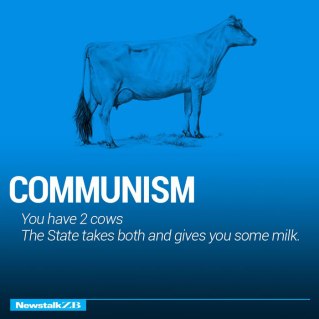
Communism would be if the government owned the businesses and their resources and shared (rather than rented) the basketballs, umbrellas, etc with the citizens…which would mean that there would be no more umbrellas at the kiosks within a few days.

but you stand in line so long for milk that it’s sour by the time you get it, if there’s any left

In fact, the “sharing” economy is actually an inaccurate and confusing name since renting and sharing are completely different. You don’t talk about how a coffee shop shared their coffee with you, and you in turn shared your money with the coffee shop (as my boss joked after I shared this article with him), so we also shouldn’t use the word share when we really mean rent or purchase. “Share” does not have the moral high ground, and there’s nothing exploitative about entrepreneurs trying to solve a unique problem in exchange for money.

Nomenclature aside, it’s still not an excuse to confuse capitalism for communism.


Past Me Would be Proud

I have a joke with one of my friends called “past me would be proud.” Both of us are still pursuing competitive distance running post-college while also balancing jobs and lives in general. It’s hard. In college, it was understood that you carved hours of your day out for practice, not to mention the 24/7 access to the training room and a dining hall full of food you don’t have to cook yourself.

Although I do still have ambitions to run faster than I did in college, I’ve also come up with other goals I can accomplish – chasing soft PRs and celebrating relative successes.

Soft PRs are in events that I didn’t run often in college – the 400, the 800, the 10k, and to an extent, the 3000 – basically anything but a 5k or 6k. I already managed a 10k PR this March, so the spring is for tackling the shorter events. Lucky for me, the Atlanta Track Club hosts All Comers track meets every year in May and June where I have the opportunity to take on some of these events without pressure (or embarrassing myself).

The first event I ran this year was the 400. I sadly didn’t get a PR (under 1:08) as I ran 1:09 which is what I almost always run the 400 in. It is hilariously predictable. If you need someone who can heal-strike their way to a 1:09, I’m your girl.

Last night I took on the 800. I had my eye on a PR and hopefully a sub-2:30. I ran it last year and managed to tie my PR (2:32), so I was excited to see what I could do this year with a goal in mind. The 800 is a strange and incredibly painful event, and I grimaced my way to a slight PR (2:31) but no dice on the sub-2:30. There’s always next year!

When I’m out of soft PRs, there’s always relative success. This is where “past me would be proud” comes into play. I’m still faster now than I was in all of high school and the beginning of college, so even if I don’t run a PR, at least I’ve got that going for me. I managed to progress every year as well, so saying “senior in high school me would be proud” is not quite as good as “sophomore year college would be proud.”

There’s something to be said for consistency as well. I feel like I’ve been stuck in between sophomore and junior year college for a while now, and when I read this quote in Runner’s World a few months ago, it stood out to me. I don’t even remember who it’s from!

“My times were nothing special in high school. I read an interview with Deena Kastor in which she talked about being consistent and believing that results will come over time. I just had this feeling that I had untapped potential and if I stuck with it, I could be successful.”

Even though I haven’t PRed in the 5k since college, I haven’t gotten slower, and there’s something to be said for all of those miles and workouts and races. I also ran under 19:50 for a 5k tempo twice in the last 2 weeks when 2 years ago I fell apart during a 5k race and ran 19:56. To run faster in a workout than I have in a race always feels really good. Plus, high school me would have killed to run under 20. 😉

Reading Makes Me Dramatic

I read All the Light We Cannot See this weekend. It’s been a long time since I read a fiction book, and it reminded me how much I love reading.

I spent much of my childhood reading. I was all about Accelerated Reader points in elementary school, and my sister and I took part in our local library’s summer reading program. I grew up with Jessica and Elizabeth Wakefield of the Sweet Valley High series, the Animorphs, and of course Harry, Hermione, and Ron. Reading before bed was my nightly routine, I’m sure well past my bedtime on occasion. Family road trips included a “book box” in the back of the van because we could never fit as many as we wanted in our backpacks (this was before kindles and smartphones and tablets). I was surprised how many memories came back the first night I laid in bed, unable to put my book down.

When I read a lot, I tend to get dramatic. I’m pretty sure everyone narrates their life in their head as they go about their day, but my narrator gets far more interesting when I’ve been reading. I imagine my life as a story and wonder what intricacies I can create to make the story more interesting. It’s certainly not that I do anything out of the ordinary, but I feel like part of my imagination that has been dormant comes to life.

The material I’m reading either increases or tempers the narrator. I don’t feel any change when I read nonfiction. I enjoy finding ways to relate what I’m reading to my life or personal development, but there’s not an emotional response like there is with fiction, and I supposed heavy fiction intensifies the emotion.

All the Light We Cannot See is a great book that I would recommend, but it is not a light read. It’s historical World War II fiction, and if living during the 1940s wasn’t bad enough, there’s the horrific addition of the war.

[light spoilers & heaviness below]

I tread carefully through the book waiting for the inevitable rape scene I had heard was coming. Page after page, and I didn’t see any scenario where it would happen. Monday evening as I neared the finish of the book, I started to feel hopeful that what I had heard was mistaken – maybe about another book. Then there it was. A few brief paragraphs, thankfully not graphic, but still awful.

They don’t teach you in school that armies would go into cities and rape the women and girls. Upon Googling it (which I don’t recommend), apparently it was very common on both sides of the war. It reminded me of the time I learned that David cut off Goliath’s head after knocking him out with his sling shot. They don’t tell you that part in Sunday School.

[you can come back now]

I think it’s ok to spend some time ruminating what makes you uncomfortable if for no other reason than to make you thankful for your current life. How privileged am I to use my imagination to create dramatic plot lines when I live in the age of the internet and general abundance and [mostly] peace?


“Is it right,” Jutta says, “to do something only because everyone else is doing it?”